Look at a dark car in direct sunlight and you will see fine circular scratching across the panels. Those are swirl marks, and almost none of them were caused by the shampoo, the mitt or the water. They were caused by grit.
Here is the mechanism. You wash the bonnet. The mitt picks up sand, brake dust and road grit. You put the mitt back into a single bucket of soapy water, where the grit stays suspended in the fibres because nothing has removed it. You reload and move to the next panel — and you have just dragged a piece of sand across the clear coat under hand pressure.
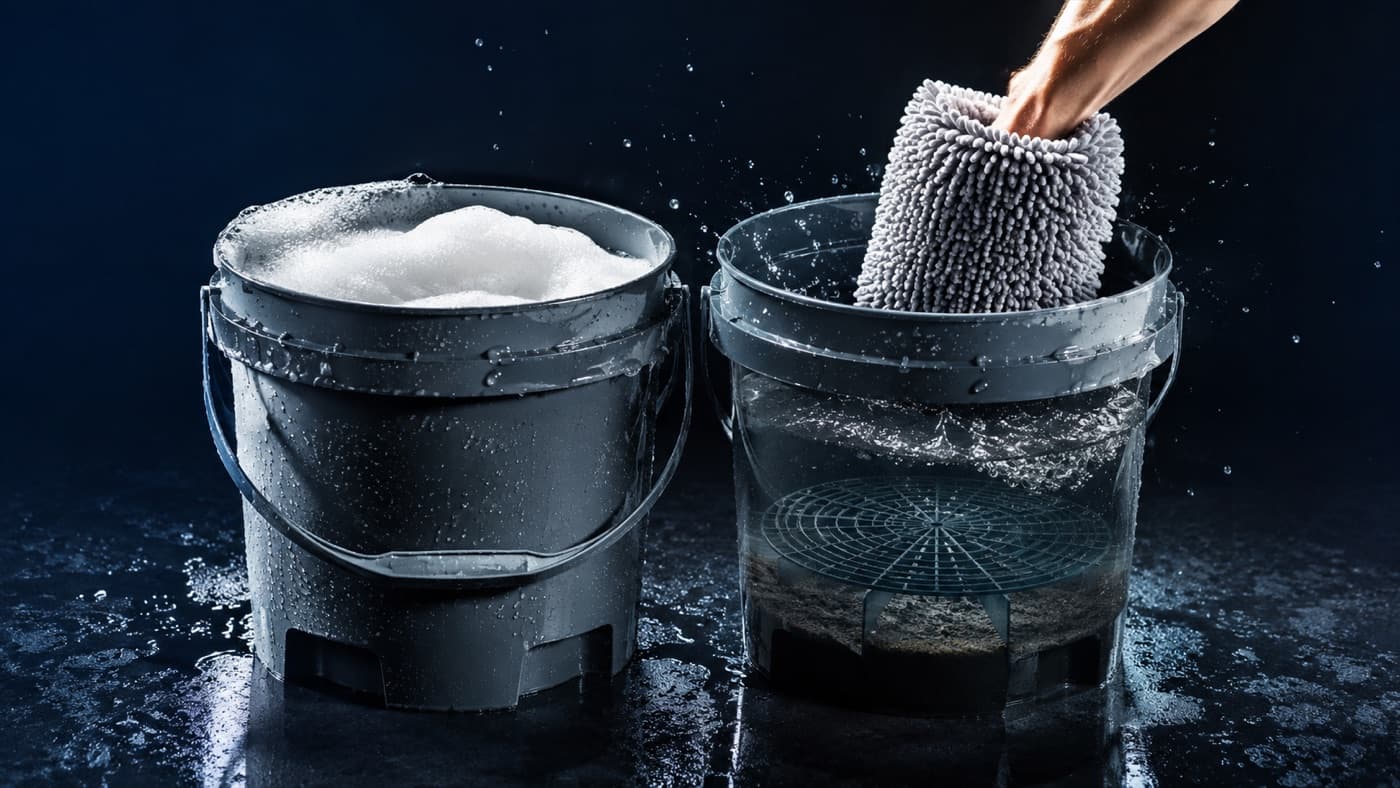
The two-bucket method breaks that cycle for about the cost of a tank of fuel. One bucket carries the shampoo solution. The other holds plain rinse water. After every panel the mitt goes into the rinse bucket, gets pressed against a grit guard so the debris falls through, and only then goes back into the shampoo. The grit ends up on the floor of the rinse bucket instead of on your paint.
Step by step
- 01
Set up in the shade, on a cool car
Never wash in direct sun or on a hot panel. Shampoo dries into a film before you can rinse it, and dried shampoo needs a second wash to remove. If the panel is warm to the back of your hand, wait.
- 02
Fill both buckets and drop in the guards
Blue bucket: shampoo at the labelled dilution — measure it, do not eyeball it. Grey bucket: plain water. A grit guard in each. Add the water with force so the shampoo foams as it fills.
- 03
Wheels first, with entirely separate kit
Wheels carry the most aggressive contamination on the car. They get their own bucket, their own brushes and their own chemistry, and none of it touches paint. Do them before you start the body, so any overspray gets rinsed away with the pre-wash.
Never use a wheel brush or wheel bucket on paint. Embedded brake dust in a wheel mitt will scratch a panel on the first pass.
- 04
Rinse the whole car, top down
An open flow from the hose carries off the loose dust before anything touches the paint. Take your time here — every particle you rinse away is one that cannot be dragged across the panel later.
- 05
Pre-wash and let it dwell
Snow foam through a hose-fed cannon, or a pump sprayer if you do not have one. Coat the car bottom-up so the foam clings on the way down, then leave it three to five minutes. Do not let it dry. Rinse top-down.
- 06
Contact wash, one panel at a time
Load the mitt from the blue bucket. Wash one panel in straight overlapping lines — never circles, because circular motion is what makes a scratch visible as a swirl. Use no pressure beyond the weight of the mitt.
- 07
Rinse the mitt against the guard, every panel
Into the grey bucket, press against the guard, agitate, lift out. This is the step people skip when they are in a hurry, and skipping it makes the other bucket pointless.
If the mitt hits the ground, it is finished for the day. Do not rinse it and carry on — grit embeds in the pile and you will not get it out.
- 08
Switch mitts below the door handles
The bottom third of the car carries the sand and the brake dust. A second mitt for the rockers, lower doors and bumpers keeps that contamination away from the upper panels where scratches are most visible.
- 09
Final rinse with an open sheeting flow
Take the nozzle off jet, let the water run out in a low-pressure sheet, and start at the roof. Surface tension carries most of the water off in one pass and leaves a fraction of what a towel would otherwise absorb.
- 10
Dry before it dries itself
Water spots are dried minerals. Lay a large twisted-loop towel flat across the roof and draw it toward you without pressure, then blot the vertical panels. Open the doors and do the shuts last.
The mistakes that cost the most
- Using dish soap
- It is formulated to strip grease, and it strips wax and sealant with it. You end up re-protecting the car every time you wash it.
- Washing in circles
- Straight lines produce scratches that scatter light in one direction. Circles produce scratches that catch the light from every angle, which is exactly what a swirl mark is.
- One bucket, no guard
- This is the default setup for most people and it is the single largest cause of self-inflicted paint damage in home car care.
- Letting the car air dry
- Every droplet leaves its dissolved minerals behind as it evaporates. On dark paint the result is visible from across the street.
- Fabric softener on microfibre
- It coats the fibres and destroys absorbency permanently. No softener, no dryer sheets, no high heat.
None of this needs anything powered, and none of it needs a professional. It needs two buckets, a bit of patience and the discipline to rinse the mitt every single panel.
Where the water goes
Wash water runoff is regulated in many US states and municipalities, and discharge into a storm drain may be prohibited where you live. Wash on grass or gravel, or use a containment mat, and check your local rules before you start.